|
Delayed members contain copies of a replica set’s data set. However, a delayed member’s data set reflects an earlier, or delayed, state of the set. For example, if the current time is 09:52 and a member has a delay of an hour, the delayed member has no operation more recent than 08:52. Because delayed members are a “rolling backup” or a running “historical” snapshot of the data set, they may help you recover from various kinds of human error. For example, a delayed member can make it possible to recover from unsuccessful application upgrades and operator errors including dropped databases and collections. ConsiderationsRequirementsDelayed members:
BehaviorDelayed members apply operations from the oplog on a delay. When choosing the amount of delay, consider that the amount of delay:
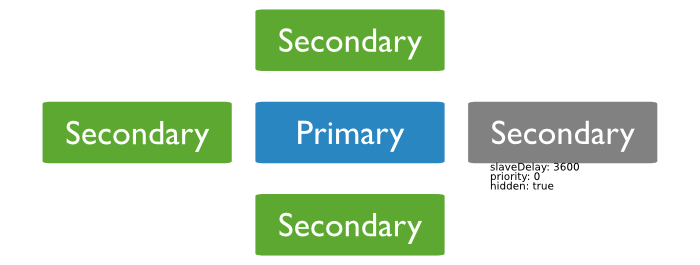
ShardingIn sharded clusters, delayed members have limited utility when the balancer is enabled. Because delayed members replicate chunk migrations with a delay, the state of delayed members in a sharded cluster are not useful for recovering to a previous state of the sharded cluster if any migrations occur during the delay window. ExampleIn the following 5-member replica set, the primary and all secondaries have copies of the data set. One member applies operations with a delay of 3600 seconds, or an hour. This delayed member is also hiddenand is a priority 0 member.
ConfigurationA delayed member has its priority equal to 0, hidden equal to true, and its slaveDelay equal to the number of seconds of delay: {
"_id" : <num>,
"host" : <hostname:port>,
"priority" : 0,
"slaveDelay" : <seconds>,
"hidden" : true}To configure a delayed member, see Configure a Delayed Replica Set Member. |